Why is the sun (le soleil) masculine and the moon (la lune) feminine?
Because they are married to each other and they belong together even
though they are opposites.
Cadaques Jordi
what is pep/nom
Nom is a parser-parser, a compiler-compiler, a text pattern recogniser,
a way of thinking about grammars, a text filter tool, a language
“translator” ...
The Pep & Nom system is a system for parsing and translating context-free
languages. It uses the Unix text-stream editing philosophy and applies it to
formal languages and patterns . Nom is (for me) an enjoyable way to
explore grammars, text patterns, syntax, translators and compilers.
The source code, examples , translation scripts and other
documentation is also at Sourceforge (and
has been for some years. Thank you!). The complete system can be
downloaded
Please check the nomstatus for an overview
of what stage this amazing parsing system is at.
what is syntagma?
Syntagma is a parsing language implemented in nom and (initially)
compiling to nom. It provides a clean EBNF-like syntax for writing
parsing scripts. It is implemented at /tr/syntagma.pss . Some simple
examples follow:
syntagma example
    lit: [(){}.,];     # create single char literal tokens
    word: [:alpha:]+;  # a word token is a sequence of alphabetic chars
    ignore [:space:];  # ignore all whitespace, horizontal and vertical

    # create a parse rule and compose the token (text) attributes
    phrase = word word | phrase word {@1 := "$1 $1";}

    # check the final parse of the script
    eof {
      stack (phrase|word) { println "found a phrase or word."; exit; }
    }
Syntagma is a much more user-friendly language than nom, because
nom is more like an “intermediate-format language” or an
assembler language.
what is nom and syntagma for ?
recognise text patterns that are too complex for regular expressions,
such as, for example, palindromes (see /eg/palindrome.pss )
explore grammars, text patterns, parsing, and compilation
techniques using a small, vm based script language.
recognise, parse, error-check, format, translate, transpile and compile
many type of patterns in text (which are called
formal languages in mathematics and
computer-science.)
Make a chatbot that responds to (more or less) natural language
queries and requests (I call this a “Tiny/Micro Language Model” )
(see /eg/chat.timeline.pss ).
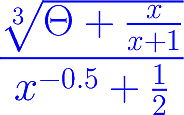
Produce formatted (in pdf) mathematical expressions from plain text
(see /eg/maths.tolatex.pss ) So a formula like
You can use nom to create a language like the
LOGO turtle
drawing language with a script like /eg/drawbasic.pss
(not complete)
you can use
NOM to create an interesting modern computer
language with a really helpful compiler. (type-checking
techniques are probably possible with the simple
pep virtual machine )
and more.
nom script examples
The folder /eg/ contains a set of example scripts written in the
NOM
language. These examples range from very simple parsing tasks such as
recognising VVpalindromes or implementing the
esoteric “brainf**k” language, to more complex examples such as an
XML
parser/error-checker, a
JSON parser, an equation formatter, a sed-to-java
translator, some 'chat' scripts, and the text-to-html script that renders
this website.
the pep/nom blog
I write a blog about the Pep/Nom system in the
(perhaps vain) attempt to publicise it and explore my own ideas about it.
There is also a journal of work that I
carry out on pep and nom . This has been a long term hobbyist project (so
far) and from time to time I will take an extended break from development,
but I find myself constantly returning in order to develop the potential of
the system further.
Another way of downloading all the source code and documentation is with
git from github.
get the system from github
git clone https://github.com/pepnom/pep
Prerequisites: a “c” compiler (I have tested with gcc and previously with
tcc the tiny c compiler ) The instructions
below are very “unixy” but the system should compile and run on Windows as
well. (I have tested it on Linux and MacOS but not Windows).
The download file is at sourceforge here
or on this site ( download.pepnom.tar.gz )
The system is about 1 megabyte compressed, which included the
interpreter, translation scripts, examples and a documentation booklet.
extract the compressed files where-ever you like
tar -xvzf download.pepnom.tar.gz
change directory into the pepnom folder
cd pepnom
compile the pep interpreter (requires some 'c' compiler)
./make.pepnom.sh
try out the pep interpreter (convert arithmetic expression to 'lisp')
./pep -f eg/exp.tolisp.pss -i "3+4/(5.1*7)"
Put the executable in your PATH variable so that you can use it
from anywhere.
There are also some bash functions in the file helpers.pars.sh
for compiling the code (and translating
nom scripts into other languages) with various options.
documentation
The main documentation for Pep & Nom is in the /doc folder
on this server. Each command in the nom language is documented in
a separate file in the /doc/commands folder.
The folder /doc/syntax/ contains explanations of each syntactical
element of the nom language, such as blocks ,
comments , tests and so forth.
Each element of the
PEP virtual machine such as the tape ,
stack and the workspace buffer (among others) is documented in
the /doc/machine/ directory on this server.
The pep interpreter is documented in the /doc/peptool/
folder.
For a number of practical example scripts see the nom example
folder.
word by word parsing and translating
# the lexical analysis phase of the scriptwhile[:space:];clear;whilenot[:space:];put;clear;add"word*";push;# the parsing/compiling phase of the scriptparse># get 2 grammar tokens off the stackpop;pop;# grammar rule:# text := ( word word ) | ( text word ) ;"word*word*","text*word*"{# format as one word per lineclear;get;add"\n";++;get;--;put;clear;# reduce 2 grammar tokens to 1 ("text")add"text*";push;.reparse}push;push;# at the end of the input stream (eof){# get the final grammar token, and print the formatted # text.pop;clear;get;print;quit;}# if not at end of input-stream, go back to# the top of script (this is an implicit loop, like in # "sed" or "awk")
This “Nom” has nothing to do with the Rust parsing library which is also
called “Nom” and is an unfortunate name clash. For this reason, I
often call the nom language “nomlang”.
translation of nom scripts
{n*}
nomicon
Nom scripts can be translated into several languages, including
rust|
dart|
perl|
lua|
go |
java |
javascript|
ruby |
python|
tcl |
c
In fact, the translation scripts can translate
themselves. This is a strangely profound corollary of writing a
parser-parser language or a compiler-compiler system.
See the /doc/ and /tr/ translation folders for more details.

 retro html